River Raid
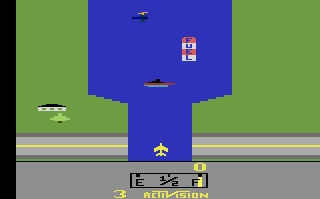
Carol Shaw's endless river, the same every time you fly it. The cartridge rebuilt from the original ROM, one instruction at a time: every bank, bridge, fuel depot and missile behaves as the real machine plays them.
How to play
Fly up the river and shoot what gets in your way. Fuel drains the whole time: fly over a depot to fill the tank before the gauge reaches E. Touch a bank, a bridge or anything on the water and the jet goes down.
At the controls
- Steer←→ or AD
- Speed up↑ or W
- Slow down↓ or S
- FireSpace / Z
- Game ResetEnter
- Pause · MuteP · M
On a gamepad
- The joystickstick or D-pad
- FireA · B · X · Y
- Game ResetStart
- PauseBack
The Atari joystick has one button and eight directions, so every face button fires. Sound starts after your first click or key press; that is the browser's rule, not the cartridge's.
Fuel
The gauge under the river runs from E to F. It drains every frame you fly, faster than it looks, and a warning tone starts once it drops below a quarter.
Fly over a depot and the tank refills while you stay on it. Shoot a depot instead and it is worth 80 points, but the fuel is gone.
Lives
You start with three jets and earn another every 10,000 points, up to nine.
After a crash the river rewinds to the start of the section and replays it exactly, because the cartridge saved its random numbers there.
$A814, every game. That is why the river never ends, and why it is the same river every time you play.The river
Thirty-two blocks make a section, and every section ends at a road and a bridge. Odd sections run straight; even ones wind and split around islands. Further up the river there are more enemies and fewer depots.

Tanker 30
Starts moving at random and patrols, turning back when it touches a bank. Where the river is too narrow for a ship, the cartridge puts a helicopter there instead.

Helicopter 60
Its rotor is two shapes swapped every other frame. Patrols like the tanker.

Jet 100
Appears from section three. Crosses the whole screen without stopping and wraps around at the edge.

Fuel depot 80
Refuels you while you fly over it, or scores if you shoot it.

Bridge 500
Shoot it to open the next section. Flying into it costs a life.

House 0
Scenery on the banks and islands, and the only thing on the river worth nothing.

Built from the ROM
This is not an emulator. Every routine of the cartridge was rewritten in JavaScript one 6502 instruction at a time, working on the same 128 bytes of RAM at the same addresses. To prove it, a small 6502 core runs the real ROM beside the port and every frame is compared, byte for byte.
- There is no score in memory. The six digits are pointers to the digit graphics, and points are added to the pointers.
- Collisions come only from the TIA's hardware latches, read once per river block. There is no collision arithmetic at all.
- Flying into a ship, helicopter or jet still scores it as you go down.
- Touching a house runs the same code as touching a fuel depot.
- When a new block has only just scrolled in, a collision at the very top is filed under a seventh block that does not exist, and the flag lands in the first object's position byte.
Developer pages
- Harness: the port with live score, fuel, lives and RAM readouts
- Inspector: the earlier ROM-visible model and its memory views
- Verifying against the ROM: the 6502 oracle and the comparison scripts